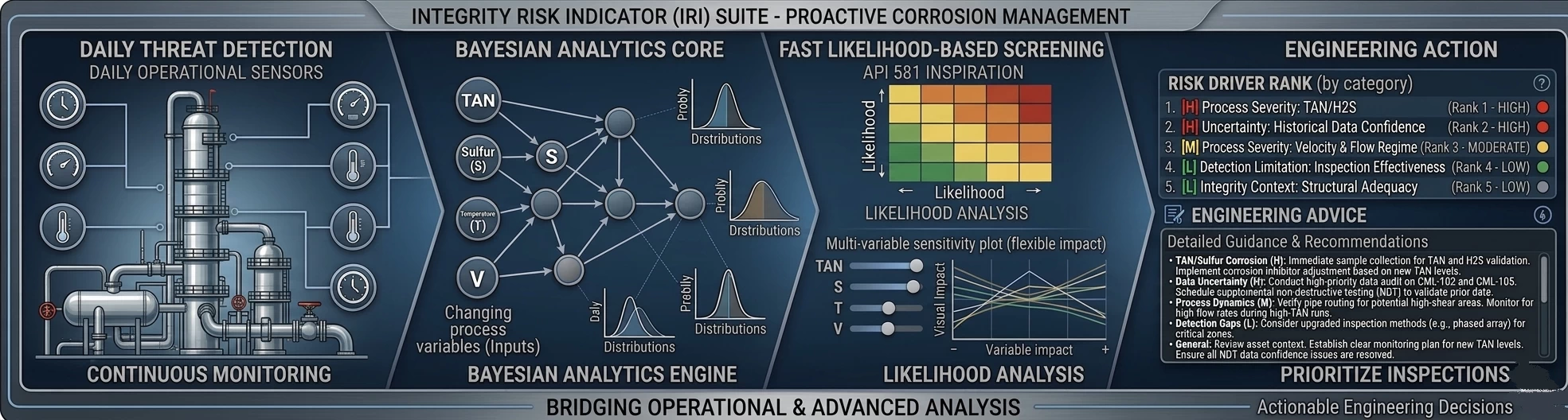
Integrity Risk Indicators (IRIs)
Maximizing petroleum profitability requires continuous optimization of operating conditions - such as adjusting a distillation column’s temperature profile to process heavier, more acidic crude blends. However, even minor operational changes can rapidly shift a system into an elevated corrosion regime, potentially accelerating asset degradation, reducing equipment reliability, and exposing facilities to unplanned outages. The economic value of process optimization is therefore inseparable from understanding and managing its integrity implications. This chapter presents Integrity Risk Indicators (IRIs), which utilize a fast, Bayesian RBI-inspired likelihood assessment engine to perform screening and sensitivity analyses within minutes. This allows process and integrity teams to evaluate operational scenarios before implementation and understand how changing conditions may influence the likelihood of degradation mechanisms and asset’s integrity. IRIs bridge the gap between day-to-day operational decision-making and the formal likelihood assessment processes underpinning full RBI studies, providing a practical framework for evaluating changing process and corrosion conditions without the effort of a complete RBI reassessment.